
Free UGC NET Hindi Mock Test 2026 – Practice Online with Solutions
Hindi has been the heartbeat of Indian literature for centuries, but cracking the UGC NET Hindi is a completely different game. Thousands of candidates appear every year, believing their love for Hindi Sahitya is enough. The toppers know better. From Kabir's dohas to Muktibodh's existential poetry, from Rasa Siddhanta to Postcolonial criticism applied to Hindi texts, the exam demands precision, speed, and analytical depth that only structured practice can build. College Vidya's UGC NET Hindi Mock Test 2026 is designed for candidates who don't just want to appear, but want to qualify, rank, and lead.

Total Tests

223k+
Users
What You'll Get
Real exam like experience with full length
Expert level questions and answers
Detailed analysis and feedback
Free UGC NET Hindi Mock Test
Why UGC NET Hindi Is Far More Than Just Language Knowledge
Most candidates walk into UGC NET Hindi preparation with one dangerous assumption, that being a Hindi speaker, reader, or graduate is enough to clear the exam. Every year, that assumption costs thousands of deserving candidates their qualifying score.
The modern UGC NET Hindi paper rigorously tests:
- Literary Period Classification: Can you correctly place a poet, text, or movement within Aadikaal, Bhaktikaal, Ritikaal, or Aadhunik Kaal without second-guessing yourself?
- Critical Theory and Aesthetics: From classical Rasa Siddhanta and Dhvani Theory to modern Marxist, Feminist, and Postcolonial literary criticism as applied to Hindi texts
- Textual Interpretation and Practical Criticism: Can you analyze an unseen passage from a Hindi literary work and identify its stylistic, thematic, and linguistic characteristics under time pressure?
- Hindi Linguistics and Grammar: Vyakaran, Phonology, Semantics, Dialect Studies, and Language Structure are consistently and heavily tested
- Comparative Literary Understanding: Connecting Hindi literature with broader Indian literary traditions, folk literature, and world literary movements
- Application Over Memorization: Questions don't just ask "Who wrote Kamayani?" They ask, "What is the philosophical and aesthetic significance of Kamayani within the Chhayavad movement and how does it reflect the spirit of its era?"
Candidates who depend only on surface-level reading and rote memorization consistently struggle with the application-based, analytical MCQs that define the modern NTA paper. Structured, exam-focused mock test practice is not optional, and it is the single most important thing you can do between now and exam day.
How Our Mock Tests Transform Your Preparation
There is a fundamental difference between attempting any mock test and attempting the right mock test, one built precisely around NTA's exam pattern, difficulty level, and question style. That difference shows up directly in your score.
- Authentic CBT Exam Experience: Our platform replicates the exact Computer-Based Test environment of the NTA examination, timed sessions, MCQ-only format, and a clean digital interface that eliminates surprises. You walk into the examination hall having already experienced what exam day feels like, calm, focused, and fully prepared.
- Speed and Accuracy Both Together: Hindi Literature MCQs are often deceptively close two options will always appear correct to an underprepared candidate. Regular mock practice trains your brain to make sharper, faster distinctions between similar answer choices, building both speed and accuracy simultaneously.
- Strategic Question Handling: Mock tests teach you the most important exam-day skill, identifying easy, high-confidence questions first, banking your time wisely, and returning to complex theory or linguistics questions with a clear and focused mind.
- Active Retention Over Passive Reading: You will remember a concept about Bhaktikal poetry or Dhvani Theory far more powerfully after getting a related MCQ wrong than after reading the same concept ten times. Our mocks make your memory work harder and smarter.
- Data-Driven, Targeted Improvement: Detailed performance reports break down your score across every section, Literary Periods, Critical Theory, Prose, Poetry, Drama, and Linguistics, so you always know exactly where to focus your next revision session.
Topics Covered in UGC NET Hindi Mock Tests
Our mock test series covers every corner of the NTA-prescribed UGC NET Hindi syllabus comprehensively, accurately, and without gaps.
Aadikaal (The Early Period)
- Origin and Development of the Hindi Language
- Apabhramsha Literature and its Significance
- Veer Ras Poetry Chand Bardai and Prithviraj Raso
- Siddha, Nath, and Jain Literature
- Characteristics and Major Works of Aadikaal
Bhaktikaal (The Devotional Period)
- Nirguna Bhakti, like Kabir, Raidas, Dadu Dayal, Namdev
- Saguna Bhakti like Tulsidas, Surdas, Mirabai, Keshavdas
- Sufi Poetry, like Malik Muhammad Jayasi, Padmavat
- Philosophical and Social Context of the Bhakti Movement
- Major Texts, like Ramcharitmanas, Vinay Patrika, Sur Sagar
Ritikaal (The Ornate Period)
- Ritisar, Ritibaddha, and Ritimukt Poetry
- Major Poets, like Keshavdas, Bihari, Bhushan, Ghananand
- Shringar Ras and Aesthetic Traditions
- Court Poetry and Patronage Culture
- Distinguishing Features of Riti Poetry
Aadhunik Kaal (The Modern Period)
- Bharatendu Yug: Rise of Modern Hindi Prose and Drama, Bharatendu Harishchandra
- Dwivedi Yug: Mahavir Prasad Dwivedi, Language Standardization, Social Reform Literature
- Chhayavad: Jaishankar Prasad, Sumitranandan Pant, Suryakant Tripathi Nirala, Mahadevi Verma, the four pillars
- Pragativad (Progressivism) : Marxist influences, Nagarjun, Kedarnath Agarwal
- Prayogvad and Nai Kavita: Agyeya, Muktibodh, Dharamvir Bharati
- Samakaleen Hindi Kavita: Contemporary voices and themes
Hindi Prose Gadya Sahitya
- Upanyas (Novel): Premchand, Jainendra Kumar, Yashpal, Nirmal Verma, Mannu Bhandari, Krishna Sobti
- Kahani (Short Story): Evolution from Premchand to the Nayi Kahani movement
- Nibandh (Essay): Hazari Prasad Dwivedi, Ram Chandra Shukla, Acharya Mahavir Prasad
- Natak and Rangmanch (Drama and Theatre): Mohan Rakesh, Jagdish Chandra Mathur, Dharamvir Bharati
- Aatmakatha, Jeevani, and Reportage: Autobiography, Biography, and Literary Journalism in Hindi
Hindi Literary Criticism Aalochana
- Acharya Ram Chandra Shukla, like History of Hindi Literature, Critical Philosophy
- Hazari Prasad Dwivedi, like Cultural and Humanist Criticism
- Namvar Singh, like Marxist Criticism, Kavita ke Naye Pratiman
- Modern Critical Approaches, like Structuralism, Deconstruction, and Feminist Criticism, have been applied to Hindi texts
- Rasa Theory, Dhvani Theory, Vakrokti, and Auchitya Siddhanta
Hindi Linguistics and Grammar
- Origin and Historical Development of Hindi
- Dialects of Hindi like Braj, Avadhi, Khadi Boli, Bundeli, Bhojpuri
- Phonology, Morphology, and Syntax of Hindi
- Semantics, Idioms, and Lokoktiyan
- Devanagari Script and Standardization
- Hindi as an Official Language under Constitutional Provisions
Folklore and Folk Literature
- Lok Geet, Lok Katha, and Folk Drama Traditions
- Regional Folk Traditions and Their Relationship with Written Literature
- Oral Literary Traditions in Hindi Belt States
UGC NET Hindi Exam Pattern 2026
Before diving deep into preparation, know exactly what you are preparing for down to the last detail.
|
Feature |
Paper 1 |
Paper 2 |
|
Number of Questions |
50 |
100 |
|
Total Marks |
100 |
200 |
|
Question Type |
MCQs |
MCQs |
|
Negative Marking |
No |
No |
|
Exam Duration |
3 Hours (Combined) |
3 Hours (Combined) |
Paper 1 evaluates Teaching Aptitude, Research Methodology, Logical Reasoning, Reading Comprehension, Communication Skills, and General Awareness sections that many Hindi candidates criminally neglect and lose 30–40 marks in.
Paper 2 is your primary battlefield, 100 MCQs spanning the entire Hindi Literature and Linguistics syllabus, testing everything from Kabir's philosophy to contemporary feminist readings of Hindi fiction.
Zero negative marking means one non-negotiable rule: attempt every single question. Leaving anything blank is simply leaving marks on the table.
What Makes College Vidya's Platform Uniquely Powerful
- AI-Powered Performance Analysis: Our platform goes far beyond showing you a score. It shows you why you scored what you did, identifying your weakest literary periods, most-missed theory questions, recurring grammar errors, and improvement trends over time with intelligent, actionable diagnostics.
- Period-Wise and Topic-Wise Sectional Tests: Not ready for a full paper today? Take a sharp, focused 20-question test on Chhayavad poetry, Rasa Siddhanta, or Hindi Linguistics and attack your weakest areas with surgical precision before moving to full-length practice.
- Difficulty-Tiered Question Practice: Begin with foundational conceptual questions, progress to moderate application-based MCQs, and then challenge yourself with advanced analytical and comparative questions. Build your confidence systematically, layer by layer.
- Timed Full-Length Mock Challenges: 150 questions. 3 hours. Real exam pressure. Our full-length mocks simulate the exact NTA CBT environment, so when exam day arrives, you are battle-tested and mentally unshakeable.
- Revision-Ready Mini Tests: Short, sharp 20-question sprint tests covering the highest-frequency topics, perfect for the final two weeks of preparation when time is precious, and focus is everything.
- Multi-Device Seamless Access: Practice on your smartphone during your commute, switch to your laptop for a full-length mock, revise on your tablet before sleep, all without any app installation, seamlessly and instantly.
Smart Strategies to Crack UGC NET Hindi 2026
- Read Primary Texts, Not Just Critical Summaries: Examiners deliberately design questions to identify candidates who have only read about a text rather than actually engaging with it. Read key chapters of Premchand's novels, key cantos of Ramcharitmanas, and selected poems of Nirala and Muktibodh in their original form.
- Master the Four Yugs with Timeline Clarity: The single most common error in UGC NET Hindi is misplacing a poet, text, or movement in the wrong literary period. Build a clear, visual timeline of all four major periods and drill it repeatedly through practice tests.
- Understand Theory: Don't just memorize that Rasa Theory was given by Bharata Muni. Understand what Rasa actually means, how it functions in a text, and how it differs from Dhvani and Vakrokti. Application-level questions demand this depth.
- Never Treat Paper 1 as Secondary: Teaching Aptitude and Research Methodology questions follow predictable patterns and are highly scoring. Dropping 30–40 marks in Paper 1 while your competitors score 80+ is an entirely avoidable catastrophe.
- Prioritize High-Frequency Authors and Texts: Kabir, Tulsidas, Premchand, Jaishankar Prasad, Nirala, Mahadevi Verma, Agyeya, Muktibodh, and Namvar Singh appear in almost every examination. Know these names deeply, not just broadly.
- Attempt Weekly Full-Length Mock Tests: The stamina required to stay focused, analytical, and accurate across a 3-hour examination is a physical and mental skill. It is built over weeks of consistent full-paper practice — not in the final few days.
- Build a Master Revision Sheet: Maintain one comprehensive, quick-reference document covering every major poet, key text, literary period, critical theorist, and important concept. This single document will save you hours during your final revision phase.
Common Mistakes That Cost Candidates the Exam
- Assuming Hindi Fluency Equals Exam Readiness: This is the most expensive mistake Hindi candidates make. Speaking and reading Hindi fluently does not prepare you for analytical, application-based MCQs under time pressure. Structured practice does.
- Confusing Poets Across Literary Periods: Misattributing a Chhayavad poem to Ritikaal, or confusing Pragativad with Prayogvad characteristics, is extremely common and entirely preventable with focused, period-wise mock practice.
- Memorizing Critical Theory Without Understanding It: If you cannot explain in your own words what Namvar Singh meant by "Kavita ke Naye Pratiman" or what Ram Chandra Shukla's critical philosophy actually argues, you are not prepared for theory-based MCQs.
- Neglecting Hindi Linguistics Completely: Grammar, Phonology, Dialect Studies, and Language History are consistently tested areas that many literature-focused candidates skip entirely and lose 15–20 crucial marks as a result.
- Not Reviewing Wrong Answers After Mock Tests: Attempting mock tests without carefully and honestly analyzing your errors is the fastest way to guarantee that you repeat the same mistakes on the actual exam day.
- Poor Paper 1 Strategy: Spending too little time on Paper 1 preparation and then scrambling through Teaching Aptitude questions on exam day is a pattern that eliminates otherwise well-prepared candidates every single cycle.
College Vidya Dashboard
The College Vidya dashboard provides a simple and smooth user experience for aspirants.
Candidates can:
- Select Philosophy mock tests easily
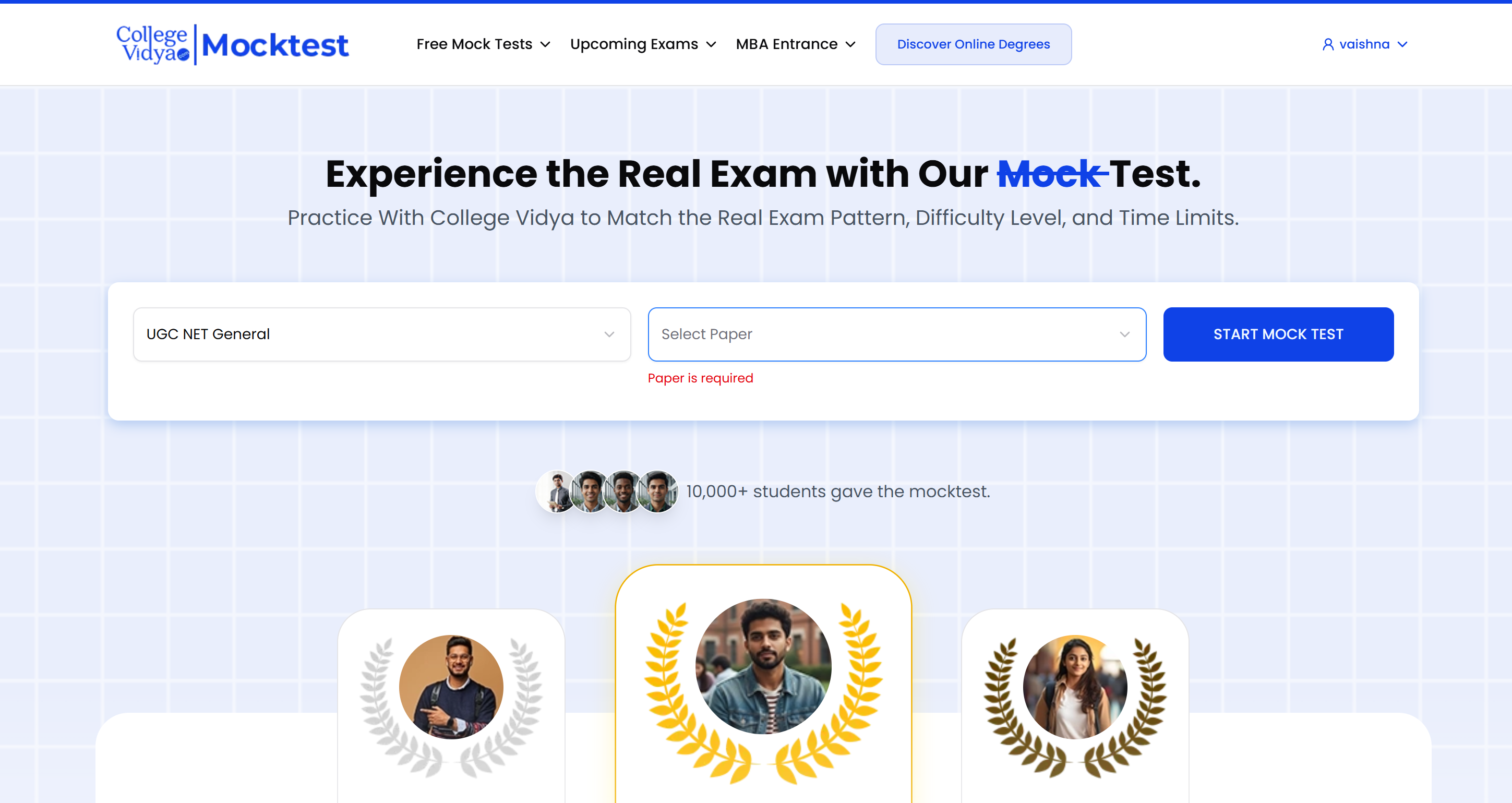
- Analyze instant performance reports
- Practise anytime according to their schedule
The platform is fully accessible across mobile phones, tablets, laptops, and desktops.
Top Universities Accepting UGC NET Hindi Qualified Candidates
Qualifying for UGC NET Hindi opens doors at India's most respected and prestigious academic institutions:
- University of Delhi
- Jawaharlal Nehru University (JNU)
- Banaras Hindu University (BHU)
- Allahabad University
- Aligarh Muslim University (AMU).
- Hyderabad Central University
- Jamia Millia Islamia
- Mahatma Gandhi Antarrashtriya Hindi Vishwavidyalaya, Wardha
- Deen Dayal Upadhyaya Gorakhpur University
- Rajasthan University
These institutions offer Assistant Professor positions, JRF fellowships, PhD research seats, and prestigious academic careers dedicated to Hindi Literature, Language Studies, and Cultural Research.
Career Opportunities After Qualifying UGC NET Hindi
Cracking UGC NET Hindi is not just a qualification it is the gateway to a respected, impactful, and intellectually fulfilling career.
- Assistant Professor in Hindi at colleges, universities, and deemed institutions across India
- Junior Research Fellow (JRF) with a funded monthly fellowship supporting full-time PhD research
- PhD Admission at central universities, IITs, and premier state universities with fellowship support
- Hindi Content Strategist and Senior Editor at publishing houses, media organizations, and digital platforms
- Academic Content Writer and Curriculum Designer for EdTech companies and school education boards
- Translation and Interpretation Specialist for government ministries, UN bodies, and international organizations
- Hindi Language Trainer for corporate organizations, government departments, and language institutes
- Doordarshan and All India Radio Broadcast journalism and cultural programming roles
- Hindi Officer in central government ministries and public sector undertakings
- Literary Journalist and Cultural Critic for national newspapers, magazines, and digital media
Benefits of Attempting UGC NET Hindi Mock Tests
Here are some points:
- Builds deep familiarity with NTA question style, difficulty level, and paper structure
- Sharpens analytical thinking and period-wise literary classification ability
- Reduces exam-day anxiety through repeated, authentic full-length practice
- Improves time management across 150 questions in a 3-hour CBT examination
- Delivers instant result analysis with section-wise and topic-wise performance breakdown
- Identifies high-frequency weak areas for targeted, strategic revision
- Builds the mental stamina and exam pacing required for sustained 3-hour performance
- Strengthens understanding of Hindi Linguistics, a consistently neglected but heavily tested area