
Free UGC NET English Mock Test 2026 – Practice Online with Solutions
English Literature is one of the most intellectually rich and competitive subjects in the UGC NET examination. From the Romantic Age and Victorian Era to Postcolonial Theory and Literary Criticism, aspirants are expected to demonstrate not just textual knowledge but sharp analytical thinking and interpretive depth. College Vidya's UGC NET English Mock Test 2026 is your most powerful weapon, like NTA-aligned, exam-focused, and built to take your preparation from "I think I'm ready" to "I know I'm ready."
Whether you're aiming for an Assistant Professorship, a Junior Research Fellowship (JRF), or a PhD seat at a top university, this is where your serious preparation begins.

Total Tests

223k+
Users
What You'll Get
Real exam like experience with full length
Expert level questions and answers
Detailed analysis and feedback
Free UGC NET English Mock Test
Why UGC NET English Is More Than Just Literature
Let's be honest, most candidates underestimate UGC NET English. They assume wide reading alone will get them through. It won't.
The modern UGC NET English paper tests:
- Textual Interpretation: Can you read between the lines of a passage and decode its deeper meaning?
- Critical Theory Mastery: From Derrida's Deconstruction to Said's Orientalism, theory questions demand conceptual precision.
- Literary History: Chronology, movements, influences, and cross-period connections matter enormously.
- Stylistics and Linguistics: Phonology, semantics, and narrative technique, these are no longer optional.
- Application Over Memory: Questions don't just ask "Who wrote it?" They ask, "What does it mean and why does it matter?"
Candidates who rely only on passive reading of texts often struggle with MCQs that require application, comparison, and critical judgment. Structured mock test practice is not optional, it is essential.
How Our Mock Tests Transform Your Preparation
Attempting a mock test is one thing. Attempting the right mock test, built around the real exam, is everything.
- Authentic CBT Exam Experience: Our platform replicates the exact Computer-Based Test environment of the NTA exam, timed sessions, MCQ-only format, and a clean interface that eliminates surprises on exam day. You walk in already knowing what to expect.
- Speed + Accuracy = Rank: English Literature MCQs can be deceptively tricky, two options will always seem correct. Regular mock practice trains your brain to make faster, sharper distinctions between close answer choices.
- Strategic Question Handling: Mock tests teach you the golden rule, identify the easy wins first, bank your time, and return to the difficult theory-based MCQs with a clear head.
- Active Retention Over Passive Reading: You will remember a concept far better after getting a related MCQ wrong than after reading it ten times. Our mocks make your memory work harder and smarter.
- Data-Driven Improvement: Detailed performance reports break down your score section by section, like Literary Periods, Critical Theory, Drama, Poetry, and Fiction, so you always know exactly where to focus next.
Topics Covered in UGC NET English Mock Tests
Our mock test series covers every corner of the NTA-prescribed UGC NET English syllabus nothing is left out.
British Literature
- Old and Middle English, like Beowulf, Chaucer, and Medieval Drama
- Renaissance and Elizabethan Age, like Shakespeare, Marlowe, and Spenser
- Metaphysical and Restoration Poetry, like Donne, Dryden, and Milton
- 18th Century, like Pope, Swift, Samuel Johnson, The Novel's Rise
- Romantic Age, like Wordsworth, Keats, Shelley, Byron, and Coleridge
- Victorian Era, like Tennyson, Browning, Hardy, George Eliot, Dickens
- Modernism, like T.S. Eliot, Virginia Woolf, James Joyce, D.H. Lawrence
- Postmodernism and Contemporary British Writing
American Literature
- Transcendentalism, like Emerson, Thoreau, and Whitman
- Realism and Naturalism, like Mark Twain, Henry James, Kate Chopin
- The Harlem Renaissance, like Langston Hughes, Zora Neale Hurston
- American Modernism, like Fitzgerald, Hemingway, and Faulkner
- Postwar and Contemporary, like Toni Morrison, Sylvia Plath, and Arthur Miller
Literary Theory and Criticism
- Classical Criticism, like Plato, Aristotle, Longinus, and Horace
- New Criticism and Formalism
- Structuralism and Semiotics, like Saussure, Barthes
- Post-Structuralism and Deconstruction and Derrida, Foucault
- Psychoanalytic Criticism, like Freud, Lacan
- Feminist Theory, like Simone de Beauvoir, Elaine Showalter, Judith Butler
- Postcolonial Theory, like Said, Spivak, and Bhabha
- Marxist and New Historicist Criticism
- Ecocriticism and Cultural Studies
Indian Writing in English
- Pioneers like Raja Rao, Mulk Raj Anand, R.K. Narayan
- Contemporary Masters like Salman Rushdie, Arundhati Roy, Amitav Ghosh, Vikram Seth
- Poetry and Drama in Indian English
Drama
- Greek Tragedy and Comedy, like Sophocles, Aristophanes
- Shakespearean Tragedy, Comedy, and History Plays
- Restoration Comedy and 18th Century Drama
- Modern and Absurdist Drama like Ibsen, Beckett, Pinter, Shaw
- Contemporary Drama and Theatre Studies
Poetry and Prosody
- Poetic Forms like Sonnet, Ode, Elegy, Ballad, Epic
- Metre, Rhythm, and Versification
- Figures of Speech and Rhetorical Devices
- Close Reading and Practical Criticism
Linguistics and Stylistics
- Phonology, Morphology, Syntax, Semantics
- Discourse Analysis and Pragmatics
- Stylistic Analysis of Prose and Poetry
- Language Acquisition and Sociolinguistics
UGC NET English Exam Pattern 2026
Before you dive into preparation, understand exactly what you're preparing for.
|
Feature |
Paper 1 |
Paper 2 |
|
Number of Questions |
50 |
100 |
|
Total Marks |
100 |
200 |
|
Question Type |
MCQs |
MCQs |
|
Negative Marking |
No |
No |
|
Exam Duration |
3 Hours (Combined) |
3 Hours (Combined) |
Paper 1 tests your Teaching Aptitude, Research Methodology, Logical Reasoning, Reading Comprehension, and Communication Skills areas, which many English candidates neglect at their own cost.
Paper 2 is your battlefield, 100 MCQs across the entire English Literature and Language syllabus, testing everything from Shakespeare's tragedies to Spivak's theories.
No negative marking means one rule: attempt every single question.
What Makes College Vidya's Platform Uniquely Powerful
Here are some points
- AI-Powered Performance Analysis: Our platform doesn't just show you your score, it shows you why you scored what you did. Identify your weakest literary periods, most-missed theory questions, and recurring error patterns with intelligent diagnostics.
- Period-Wise and Theory-Wise Sectional Tests: Don't want to attempt a full paper today? Take a sharp 20-question test on Postcolonial Theory or Victorian Poetry and target your weakest spots with laser precision.
- Difficulty-Tiered Practice: Start with conceptual beginner questions, progress to moderate application MCQs, and then tackle advanced comparison and analysis questions, building your confidence layer by layer.
- Timed Full-Length Mock Challenges: 150 questions. 3 hours. Real pressure. Our full-length mocks simulate the exact CBT environment so you arrive on exam day battle-tested, not surprised.
- Revision-Ready Mini Tests: Short 20-question sprint tests covering high-frequency topics perfect for the final two weeks before your exam.
- Multi-Device Access: Study on your phone during your commute, switch to your laptop for a full mock, and revise on your tablet before bed seamlessly, without installation.
College Vidya Mock Test Dashboard
The College Vidya dashboard is designed to provide a smooth and interactive learning experience.
Candidates can:
- Select the Mass Communication mock tests easily
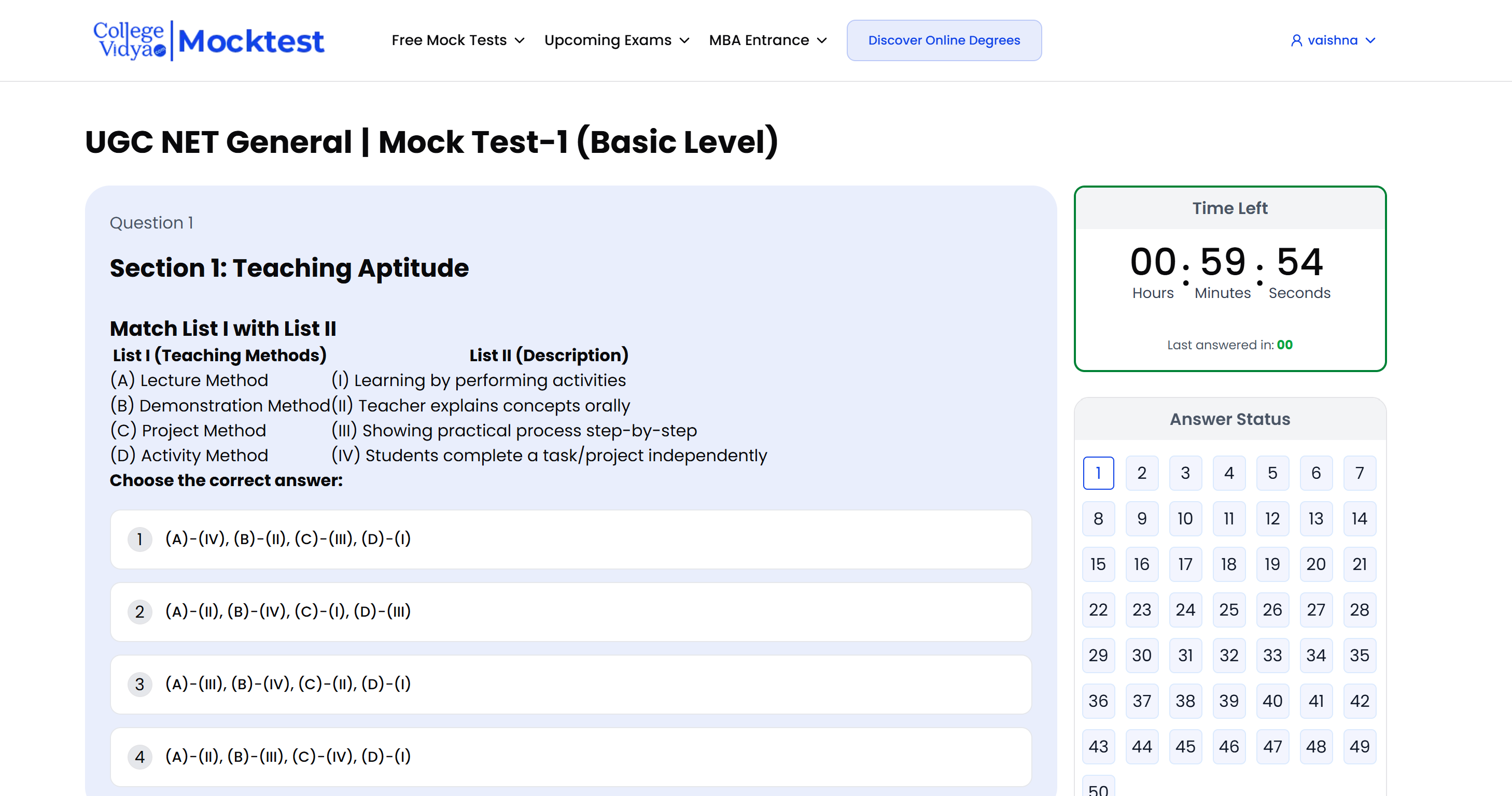
Attempt full-length and topic-wise tests
- Monitor preparation improvement regularly
The dashboard is accessible across smartphones, tablets, laptops, and desktops.
Smart Strategies to Crack UGC NET English 2026
- Read Primary Texts, Not Just Summaries: Examiners design questions to catch candidates who've only read plot summaries. At least read key chapters, famous speeches, and celebrated poems in their original form.
- Master Critical Theory with Examples: Don't just memorize theorist names. Understand what Derrida actually meant by différance, or what Said really argued in Orientalism. Apply the theory, don't just recall it.
- Never Neglect Paper 1: Teaching Aptitude and Research Methodology questions are highly predictable and consistently score. Dropping marks here is simply avoidable.
- Prioritize High-Frequency Authors: Shakespeare, Milton, Keats, T.S. Eliot, Toni Morrison, and Salman Rushdie appear in almost every paper. Know them deeply, not broadly.
- Attempt Weekly Full Mock Tests: Stamina for a 3-hour examination is built over weeks, not days. Make weekly full-length mock tests non-negotiable.
- Build a Theory Cheat Sheet: Maintain a one-page quick-reference guide for every major theorist's key concept, key text, and key quote. It will save you hours during revision.
Common Mistakes That Cost Candidates the Exam
- Ignoring Paper 1 Completely: This is the single most expensive mistake English candidates make. Paper 1 carries 100 marks. Losing 30–40 marks here while your competitors score 80+ is simply unacceptable.
- Confusing Literary Periods and Movements: Misattributing a Romantic poem to the Victorian era or mixing up Modernism and Postmodernism is extremely common, and entirely avoidable with focused mock practice.
- Memorizing Theories Without Understanding Them: If you can't explain what Foucault meant by "power-knowledge" in your own words, you haven't learned it well enough to answer tricky MCQs about it.
- Skipping Close Reading Practice: The ability to analyze an unseen passage is directly tested. If you haven't practiced practical criticism regularly, unfamiliar passages will feel overwhelming.
- Not Reviewing Wrong Answers: Attempting mock tests without carefully analyzing your errors is the fastest way to guarantee you repeat the same mistakes on exam day.
Top Universities Accepting UGC NET English Qualified Candidates
Qualifying for UGC NET English opens doors at India's most prestigious academic institutions:
- University of Delhi
- Jawaharlal Nehru University (JNU)
- Hyderabad Central University
- Jadavpur University
- Jamia Millia Islamia
- Banaras Hindu University (BHU)
- University of Allahabad
- Aligarh Muslim University (AMU)
- English and Foreign Languages University (EFLU), Hyderabad
- Symbiosis International University
These institutions offer Assistant Professor positions, JRF fellowships, PhD research seats, and prestigious academic careers in English Literature and Language Studies.
Career Opportunities After Qualifying For The UGC NET English
Cracking UGC NET English isn't just about getting a job, it's about building a career that matters.
- Assistant Professor in English Literature at colleges and universities
- Junior Research Fellow (JRF) with a funded monthly fellowship for PhD research
- PhD Admission at IITs, IIMs, central universities, and state universities
- Content Strategist and Senior Editor at publishing houses and media organizations
- Academic Content Writer for EdTech and education platforms
- Curriculum Designer for school boards and education companies
- Corporate Communication and Training Specialist
- Literary Journalist and Cultural Critic
- Translator and Interpreter for government and international organizations
- IELTS/TOEFL/English Language Trainer
Benefits of Attempting UGC NET English Mock Tests
- Builds deep familiarity with NTA question style and difficulty level
- Sharpens analytical thinking and close reading ability
- Reduces exam-day anxiety through repeated authentic practice
- Improves time management across 150 questions in 3 hours
- Delivers instant result analysis with section-wise performance breakdown
- Identifies high-frequency weak areas for targeted revision
- Builds the stamina and mental pacing required for a 3-hour CBT exam